Getting started4 min read
What is a blockchain? A KURV starter
A blockchain is a public record many computers keep in sync. How that record holds every KURV collection, and the mistakes new collectors make.
KURV teamAlso in Español, Português (Brasil)
On this page11 sections
Every piece you mint on KURV is recorded on a blockchain. You don’t need to understand the engineering to use it, but knowing the basic idea makes everything else on KURV (ownership, the Vault, why some things can’t be changed) make sense.
One shared notebook
A blockchain is a list of records, like “piece #12 belongs to this wallet”, that thousands of computers keep identical copies of. No single company holds the master copy. When something new happens, the network checks it, agrees on it, and every copy adds it.
Compare that with a normal app. If a website says you own a drawing, that’s a row in the company’s database. The company could edit it, lose it or shut down. A blockchain record doesn’t depend on any one company staying around.
Blocks, and why they’re chained
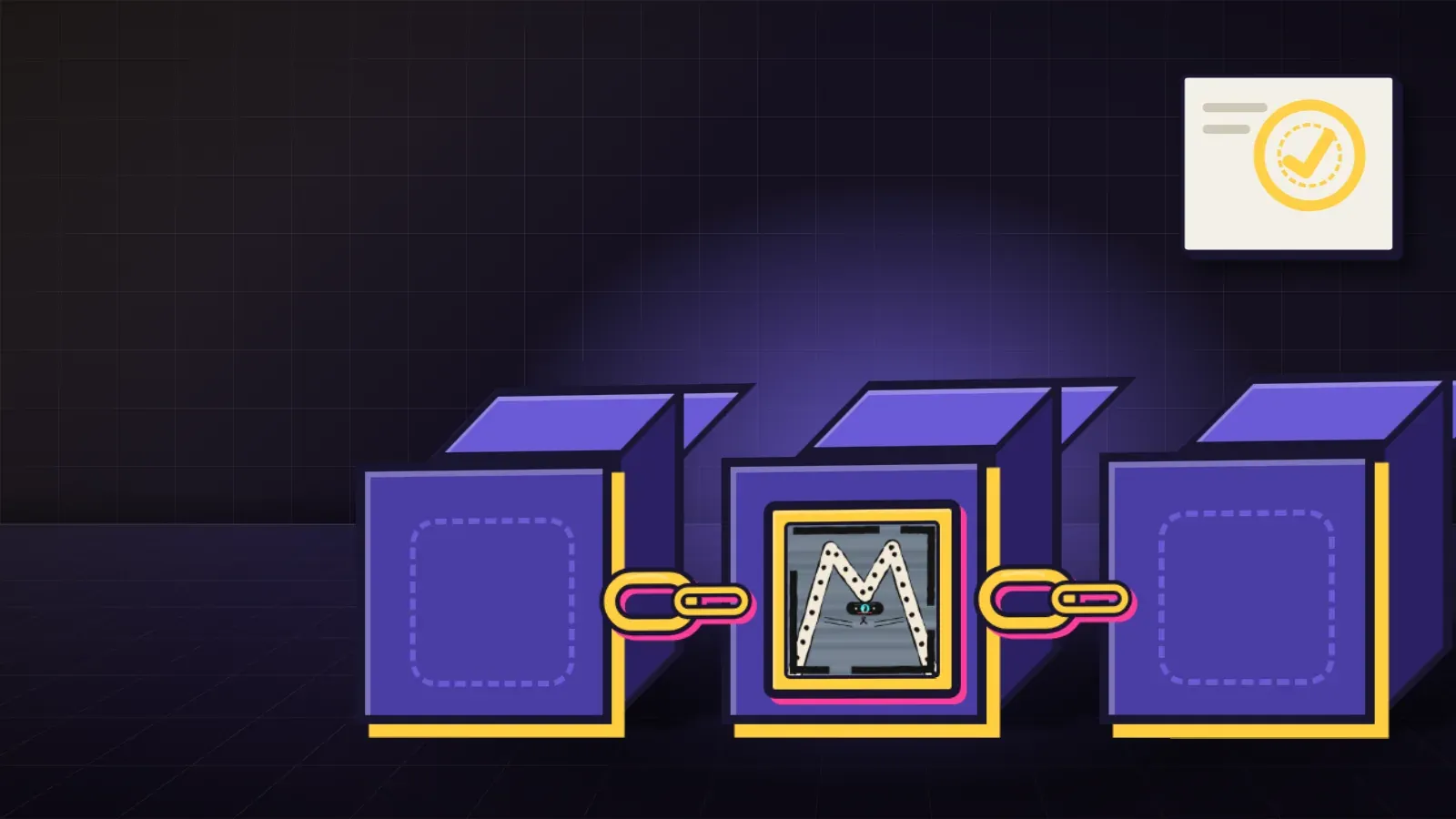
New records are bundled into blocks. Each block contains a fingerprint (a hash) of the block before it. Change one character of an old record and its fingerprint changes, so the next block stops matching, and so does everything after. Every honest copy would disagree with the edited one, which is why old records effectively can’t be rewritten.
Smart contracts: rules that live on the chain
Blockchains like Base also store small programs called smart contracts. A contract lives at its own address and runs exactly as written whenever someone uses it. Every collection launched on KURV gets its own contract and its own Vault. The contract keeps track of which piece belongs to which wallet and enforces the collection’s rules.
That’s why some things on KURV are described as “fixed for the life of the collection”. Once a creator signs, the contract holds those settings, and nobody (not the creator, not KURV) can quietly change them.
Following one mint, step by step
Here’s what happens when you mint a piece on KURV:
- You log in. KURV made a wallet for you the first time you did.
- You open a collection’s mint page on testnet.kurv.fun and tap Mint.
- You confirm once in your KURV wallet.
- The collection’s contract checks the sale rules and creates the piece.
- The piece is recorded as belonging to your wallet, in a new block.
- The piece shows up in your wallet on KURV, and anyone can look up the record.
What that gives you
- Proof you own it. Your piece is tied to your wallet on the chain, not only to a row in KURV’s database.
- History anyone can check. Every mint and sale is on a public record.
- Rules that run the same way every time. A Vault’s backing, a collection’s royalty and its supply are enforced by contracts.
- Portability. Because the piece is on the chain, you can move it to another wallet.
What a blockchain doesn’t do
- It doesn’t make anything private. The history of a wallet is public.
- It can’t undo mistakes. Send a piece to the wrong address and it’s gone.
- It can’t tell an original from a copy. Anyone can deploy a contract with a familiar name. The official collection is the one on its KURV page.
- It doesn’t set prices. Prices are up to the market, and neither KURV nor the chain promises any.
Which chains
KURV runs on testnet today, on Base Sepolia and Solana Devnet, where coins are free and nothing has value. They are different blockchains with different addresses and wallets, so a piece lives on the chain its collection was launched on. Base and Solana basics: what “choose your chain” means covers the difference.
A concrete example
Ana mints piece #12 from a cat collection on KURV. The collection’s contract records “#12 belongs to Ana’s wallet”. A week later she sells it to Leo on KURV’s market. The contract records the new owner, the creator’s royalty is paid according to the collection’s fixed settings, and the history now shows both owners. If KURV’s website went offline for an hour, the record would still say Leo owns #12.
Common mistakes
- Thinking “on the blockchain” means “official”. Copycat collections exist on every chain. Check you’re on the collection’s page at testnet.kurv.fun.
- Expecting a creator to change settings later. Supply, coin, mint share and royalty are fixed once the collection launches.
- Assuming you can reverse a transfer. You can’t.
- Treating a wallet as anonymous. It’s public, just without your name on it.
- Thinking the website is the record. The site shows the chain; the chain is the record.
FAQ
Do I need to understand blockchains to use KURV? No. Log in, browse, mint. This is just the why behind it.
Who controls my pieces? Your wallet. KURV makes it for you when you sign up, and you can take your things elsewhere.
Can KURV change a collection’s rules after launch? The core settings are fixed in the collection’s contract once the creator signs.
Is Base a company? No. Base is a network built on Ethereum, made by Coinbase. KURV is an app that launches collections on Base and Solana.